Unlock your business dreams! Learn how SBA loans simplify financing a small business acquisition. Get expert tips and start your venture today.
February 26, 2026

Financing a small business acquisition gives you a proven path to business ownership without starting from scratch. Here's what you need to know:
Main Financing Options:
Key Requirements:
Buying an existing business is often easier to finance than starting one from scratch. Why? The business already has proven revenue, customers, and operations. Lenders can see real performance data instead of just projections.
Global merger and acquisition activity rose by 10% in the first 9 months of 2025 compared to the same period a year earlier. More business owners are finding that acquisition is one of the smartest ways to grow quickly.
But here's the challenge: navigating the financing landscape can feel overwhelming. Traditional banks take 90+ days while sellers want 30-day closings. Many buyers underestimate the total cash needed, focusing only on the down payment while forgetting closing costs and working capital.
The good news? SBA loans have become the backbone of small business acquisitions because they offer up to 90% financing with lower down payments than conventional loans. The SBA guarantees up to 85% of these loans, which reduces lender risk and opens doors for more buyers.
I'm Cesar DonDiego, and through my work in finance and accounting, I've guided business owners through complex financial decisions including financing a small business acquisition, helping them structure deals that support long-term growth while minimizing tax liability. My goal is to help you gain the clarity and confidence needed to make your acquisition successful.
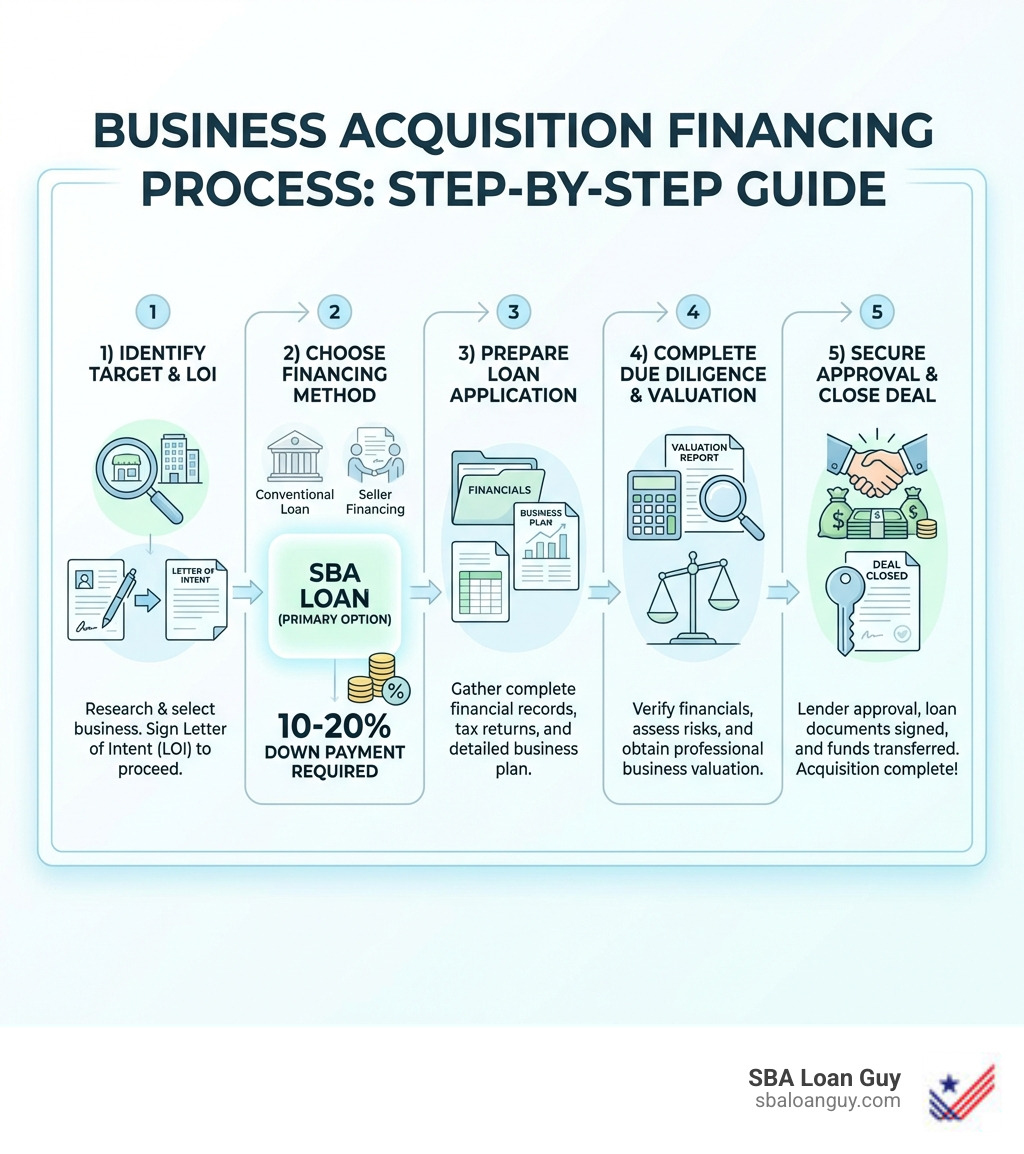
When you decide to buy a business, the first question is always: "How am I going to pay for this?" Unless you have a giant mountain of cash sitting in your backyard, you will need to look at different ways to get the money. Think of it like buying a house, but instead of just a roof and walls, you are buying a machine that makes money every single day.
There are a few big ways people get the money they need:
| Benefit | SBA 7(a) Loan | Traditional Bank Loan |
|---|---|---|
| Down Payment | 10% to 20% | 20% to 40% |
| Repayment Time | Up to 10-25 years | 1 to 7 years |
| Interest Rates | Competitive / Capped | Varies (often higher) |
| Government Backing | Yes (up to 85%) | No |
If you are looking at financing a small business acquisition in a place like Houston, Chicago, or New York City, the SBA 7(a) loan is likely your best friend. It is the most popular path for a reason.
With an SBA 7(a) loan, you can get up to $5 million to buy a business. That is a lot of lemonade stands! The best part is the time you get to pay it back. For most business purchases, you get 10 years. If the business comes with a building (real estate), you might even get 25 years to pay it back. This keeps your monthly payments low so you have more cash to grow the business.
The SBA doesn't actually hand you the check. Instead, they give the bank a "guarantee." For loans over $150,000, they usually guarantee 75% of the loan. For smaller loans, it can be up to 85%. This safety net is why banks are okay with you only putting down 10% of the price. You can find more details in the SBA 7(a) Loan Program Guidelines.
Getting an SBA loan is a bit like a team sport. You are the captain, the bank is the player, and the SBA is the referee making sure everyone follows the rules. To win the game, you need to show that the "machine" (the business) you are buying works well and that you know how to drive it.
Lenders look at "The 5 C’s of Finance" to decide if they will give you the money:
The "20% Rule" is something we talk about a lot. While some deals only need 10% down, the SBA often looks for an "equity injection" (that's just a fancy word for down payment) of 10% to 20%. This shows you have "skin in the game." If you don't have all the cash, sometimes the seller can help you by letting you owe them part of the down payment—we call this seller financing on "standby."
We know that paperwork can be scary, but we make it simple. Here is the path we take our clients on:
You can see exactly how the process works on our website. We guide you through every single turn.
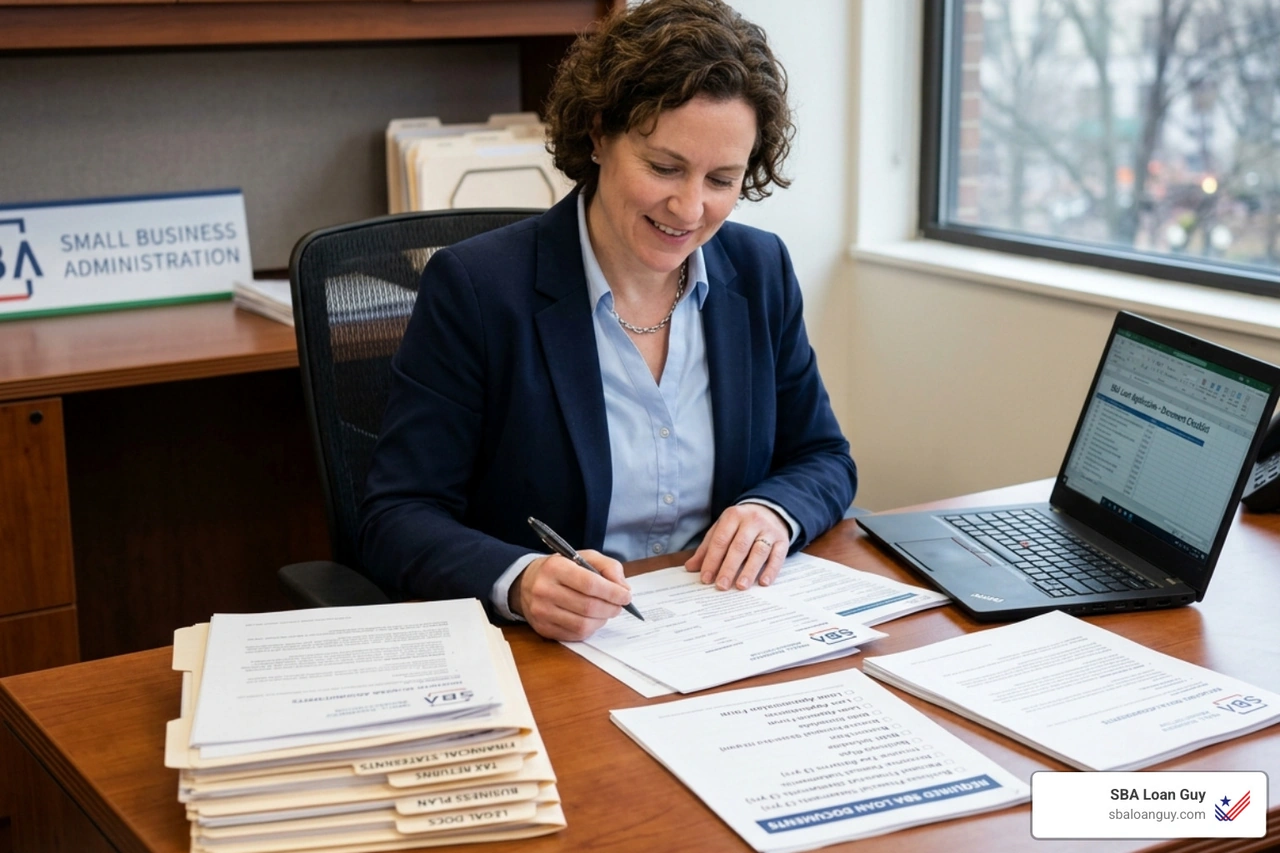
Lenders love paper. To get a "Yes," you will need to show them the history of the business and your own history. Think of it like a background check for your wallet.
You will need:
If you need a smaller amount of money quickly, you might want to look at More info about SBA Express loans. These move faster but usually have a lower limit on how much you can borrow.
Before you buy a car, you look under the hood. Before you buy a business, you look at the "EBITDA." That stands for Earnings Before Interest, Taxes, Depreciation, and Amortization. It's a big mouthful, but it just means "How much cash does this business actually make?"
When financing a small business acquisition, the value is usually a "multiple" of the profit. For example, if a small shop in San Francisco makes $200,000 a year in profit, a buyer might pay 3 times that amount ($600,000) to buy it.
But wait! Sometimes the owner pays for their personal car or a family vacation using the business's money. We "add back" those costs to see the "Normalized EBITDA." This shows the true health of the business. If the profit margins are getting smaller every year, that is a red flag. If they are growing, that is a green flag!
Don't just look at the bank account. You need to be a detective. Check these things:
Lenders want to see a Debt Service Coverage Ratio (DSCR) of at least 1.25x. This means for every $1 you owe the bank, the business should make at least $1.25 in profit. This extra $0.25 is your "safety cushion" for when things get tough.
Want to know if the deal you found is a good one? You can see if you pre-qualify right now. It takes just a few minutes and gives you a clear picture of your buying power.
Buying a business is exciting, but you have to be smart. It’s like eating a giant pizza—it’s great, but if you eat too much too fast, you’ll get a stomachache. In the business world, a stomachache is called "too much debt."
Here are some tips to keep your new venture healthy:
If you are buying a business in an area that was hit by a storm or other trouble, you might qualify for special help. Check out More info about SBA disaster loans to see if that applies to your situation.
Most people use a "Multiple of Earnings." You take the true profit (EBITDA) and multiply it by a number (usually between 2 and 5 for small businesses). You can also look at "Asset Value," which is just adding up the price of all the desks, trucks, and computers the business owns.
Seller financing is when the seller acts like a bank. Instead of you giving them all the money on day one, you give them some, and then pay the rest over a few years.
In an SBA deal, this is very helpful! If the SBA says you need a 10% down payment, but you only have 5%, the seller can sometimes provide the other 5% as a "standby" loan. This means you don't have to pay the seller back until the SBA loan is finished or after a certain number of years. It’s a great way to close a deal when you are a little short on cash.
This can get complicated, but generally, if you buy the assets of a business, you can often "depreciate" them. This is a fancy way of saying you can tell the IRS the equipment is getting older, which helps you pay fewer taxes. If you buy the stock, you are taking over the whole history of the company, including any old mistakes they made. Most small buyers prefer an "Asset Purchase."
Financing a small business acquisition is one of the fastest ways to change your life. You aren't just getting a job; you are getting an engine that builds wealth for your family. Whether you are in Indianapolis, Orlando, or California, there are amazing businesses waiting for a new leader like you.
At SBA Loan Guy, we don't just fill out forms. We are your partners. We help you find the right lender, fix your application so it looks perfect, and walk with you all the way to the finish line. We know the rules in places like The Woodlands and Houston because we live and work here too.
Ready to stop dreaming and start owning? Let's get to work. Start your business purchase today and let us help you open up your next venture!

A distilled, 0–100 snapshot of how fundable you are based on credit, cash flow, equity, and documentation. Plus the top fixes to raise your score fast.
A curated shortlist of lenders that fit your profile and use of funds, with why each is a fit and exactly what they’ll want to see.
A tailored, step-by-step list of required docs and forms (formats, who provides them, and common pitfalls to avoid).
A realistic week-by-week path from pre-qual to closing, with milestones, dependencies, and an estimated target funding date.
Hands-on prep and documentation for SBA disaster programs (EIDL and others), including submissions, follow-ups, and guidance through appeals or requests for more info.
We prepare your application, match you with the
right lenders, and guide you until funding.