Learn 504 sba loan requirements, eligibility, and how the program works to finance real estate and equipment for your small business.
July 15, 2026
Understanding 504 SBA loan requirements is the first step toward securing one of the most affordable financing options available to small business owners today.
Here is a quick snapshot of the core requirements:
| Requirement | Details |
|---|---|
| Business type | For-profit, operating in the U.S. |
| Tangible net worth | Less than $20 million |
| Average net income | Less than $6.5 million after taxes (prior 2 years) |
| Minimum down payment | 10% |
| Minimum credit score | 680+ (varies by lender) |
| Maximum loan amount | $5.5 million ($5 million standard) |
| Eligible uses | Real estate, construction, long-term equipment |
| Ineligible uses | Working capital, inventory, speculative real estate |
| Loan terms | 10, 20, or 25 years |
| How to apply | Through a Certified Development Company (CDC) |
The SBA 504 loan program gives small businesses access to long-term, fixed-rate financing for major fixed assets — things like buildings, land, and heavy equipment. It is not a one-size-fits-all loan. It has a specific structure, specific rules, and specific goals: business growth and job creation.
If you have good credit, a solid business history, and a project tied to real assets, this program could be your most cost-effective path to growth financing.
I'm Cesar DonDiego, a finance and accounting professional with hands-on experience helping business owners navigate complex funding decisions, including 504 SBA loan requirements and long-term capital planning. In this guide, I'll walk you through everything you need to know — clearly and without the jargon.

Similar topics to 504 sba loan requirements:
Imagine you want to buy a big building for your business, but the bank wants a giant down payment that you cannot afford. This is where the SBA 504 Loan Program comes to the rescue.
The SBA 504 loan program is a special partnership designed to help small businesses grow. It does this by offering long-term, fixed-rate financing to buy "fixed assets." Fixed assets are big, physical things that do not move easily, like land, buildings, or huge machinery.
The main goal of this program is to help communities. The government wants you to use this money to grow your business, hire more workers, and make your local economy stronger. Because the government guarantees a portion of the loan, lenders are much more willing to work with you and offer lower interest rates.
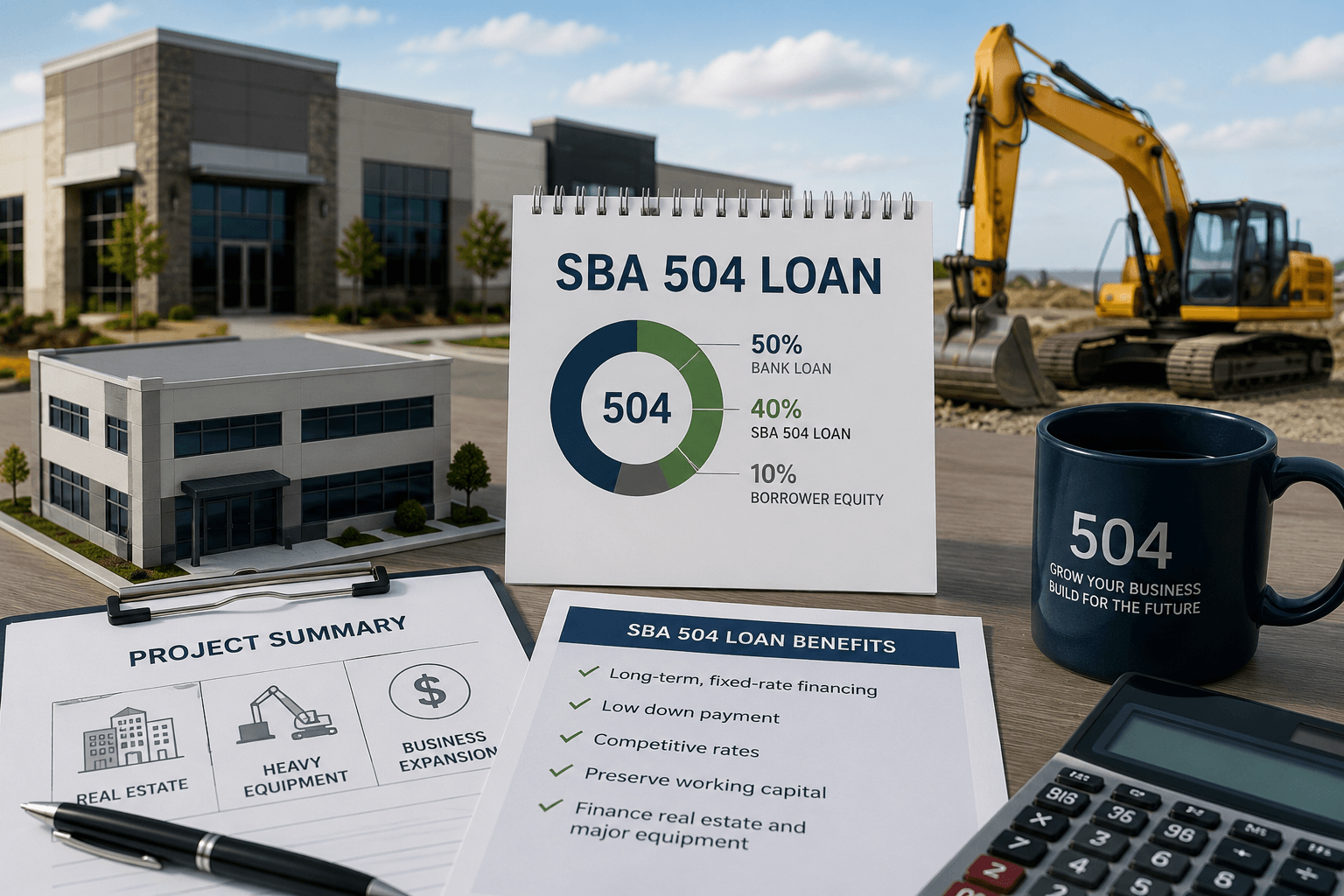
The coolest part about the SBA 504 loan is how it is structured. It is not just one loan from one bank. Instead, it is a team effort made of three different parts. We call this the 50-40-10 split:
This structure is a huge win for you. With a regular commercial loan, a bank might ask you to put down 20% to 30% of the total cost. By keeping your down payment at just 10%, you get to keep more cash in your business bank account to pay your workers, buy inventory, and handle daily expenses.
How much can you actually borrow? The SBA 504 program is built for large projects.
That because the CDC portion only represents 40% of the total deal, your overall project size can actually be much larger—often up to $12.5 million or more when you add the bank's 50% share!
When it comes to paying the money back, you get plenty of time. The SBA offers three maturity terms:
The interest rates on the CDC portion of the loan are incredibly friendly. They are fixed, meaning they will never go up during the life of your loan. These rates are pegged to a tiny margin above current U.S. Treasury Index rates. Typically, the interest rates for the CDC portion run between 2.08% and 2.18% above the relevant U.S. Treasury Index. This makes them some of the cheapest long-term rates you can find anywhere. For the official, most up-to-date rate details, you can view the Official SBA 504 Loan Details.

Before you start picking out paint colors for your new building, we need to make sure your business meets the official 504 sba loan requirements. The SBA wants to make sure they are lending to healthy, honest, and hardworking businesses.
To qualify, your business must meet these basic rules:
To learn more about the basic rules for all SBA options, check out our guide on SBA Loan Requirements.
The SBA 504 loan is specifically for "small" businesses, but the SBA's definition of "small" is actually quite generous! To make sure your business is eligible, you must meet the following financial limits:
If your business fits under these limits, congratulations! You meet the financial size standards for the program. You can read more about these specific limits in our article on SBA 504 Eligibility Criteria.
The SBA 504 loan is meant for businesses that actually use the real estate they buy. It is not meant for landlords who just want to rent out space to make easy money. Because of this, the SBA has strict "occupancy rules":
Additionally, your project must help the community in some way. Usually, this means your project must meet job creation goals. The standard requirement is that your project must create or retain at least one job for every $65,000 borrowed from the SBA (or one job per $120,000 for small manufacturers).
If your project does not create enough jobs, you can still qualify if it meets a public policy goal. These goals include things like:
One of the most important 504 sba loan requirements is how you spend the money. The SBA is very strict about what you can and cannot buy with these funds.
You can use your SBA 504 loan for major physical assets that will help your business run for a long time. This includes:
Because the 504 loan is designed strictly for fixed assets, you cannot use the money for daily operating costs. Ineligible uses include:
To secure an SBA 504 loan, you must show the lenders that you are financially stable and ready to manage the debt.
While the standard down payment is 10%, there are two situations where the SBA will ask you to bring a bit more cash to the table:
For credit scores, most lenders want to see a personal credit score of 680 or higher from all major business owners. Additionally, anyone who owns 20% or more of the business must sign a personal guarantee. This means you promise to pay the loan back personally if the business fails.
When preparing your application, you will need to gather several financial records. To make sure you have everything ready, take a look at our checklist of SBA Loan Required Documents.
Once your loan is closed and you move into your new building, your job is not quite done. You must follow several "post-closing covenants" to keep your loan in good standing:

Many business owners ask us: "Should I get an SBA 504 loan or an SBA 7(a) loan?" Both are fantastic programs, but they serve very different purposes.
To put it simply, the SBA 7(a) loan is like a Swiss Army knife. It is highly versatile. You can use it to buy inventory, get working capital, refinance high-interest debt, or even buy an existing business. However, it often comes with variable interest rates, meaning your monthly payment can go up or down over time.
On the other hand, the SBA 504 loan is like a heavy-duty bulldozer. It is built specifically for huge, long-term physical projects like real estate and heavy machinery. It offers incredibly stable, fixed interest rates and a unique three-party lender structure.
Here is a quick comparison table to help you see the differences:
| Feature | SBA 504 Loan | SBA 7(a) Loan |
|---|---|---|
| Primary Use | Real estate, land, heavy equipment | Working capital, inventory, business acquisition, debt refinance |
| Interest Rate | Fixed (pegged to U.S. Treasuries) | Variable or Fixed (pegged to Prime Rate) |
| Down Payment | Typically 10% (up to 20%) | Varies (10% to 15% typical) |
| Structure | Bank (50%) + CDC (40%) + Borrower (10%) | Single lender (backed by SBA guarantee) |
| Closing Time | Typically 65 to 75 days | Typically 30 to 60 days |
For a deeper dive into choosing the right path for your specific situation, read our expert SBA Loan Guidance.
We have some very exciting news for businesses in July 2026! The SBA recently announced a major policy change that doubles the cumulative loan limits for business owners.
Under the new rules, the SBA has doubled the combined 7(a) and 504 loan limit to $10 million.
Previously, you were limited to a total of $5 million across both programs. Now, you can access record levels of funding. For example, a small manufacturer can use a $5 million SBA 7(a) loan for working capital and purchasing inventory, while simultaneously using a $5 million SBA 504 loan to buy a brand-new manufacturing plant. This policy change is a massive boost for capital-intensive industries and small manufacturers looking to scale rapidly.
It typically takes between 65 to 75 days to close on a real estate loan under the SBA 504 program. Because the loan involves three parties (you, your private bank, and the CDC), there is a bit more paperwork and coordination required compared to a standard bank loan. Working with an experienced partner can help speed up this process.
No, you cannot. Working capital and inventory are strictly ineligible uses of SBA 504 funds. If you need working capital, you should look into combining your 504 loan with an SBA 7(a) loan, which is designed exactly for those needs.
To qualify for the larger $5.5 million green energy limit, your project must meet one of these "going green" goals:
Navigating 504 sba loan requirements can feel a bit overwhelming, but you do not have to do it alone. The rewards—low fixed interest rates, a tiny 10% down payment, and 25-year terms—are absolutely worth the effort.
At SBA Loan Guy, we are dedicated to making this journey as simple and stress-free as possible. Based in The Woodlands, TX, we proudly serve business owners across our key operating locations, including:
We help you by preparing your SBA loan application, crafting a personalized pre-qualification snapshot, matching you with the perfect lenders, and guiding you step-by-step all the way to funding.
Ready to see if you qualify? Connect with our SBA Loan Specialists today, or visit us online to Get Started with SBA Loan Guy!

A distilled, 0–100 snapshot of how fundable you are based on credit, cash flow, equity, and documentation. Plus the top fixes to raise your score fast.
A curated shortlist of lenders that fit your profile and use of funds, with why each is a fit and exactly what they’ll want to see.
A tailored, step-by-step list of required docs and forms (formats, who provides them, and common pitfalls to avoid).
A realistic week-by-week path from pre-qual to closing, with milestones, dependencies, and an estimated target funding date.
Hands-on prep and documentation for SBA disaster programs (EIDL and others), including submissions, follow-ups, and guidance through appeals or requests for more info.
We prepare your application, match you with the
right lenders, and guide you until funding.