Learn how an Export Express loan helps small businesses fund international sales with fast SBA financing.
June 23, 2026
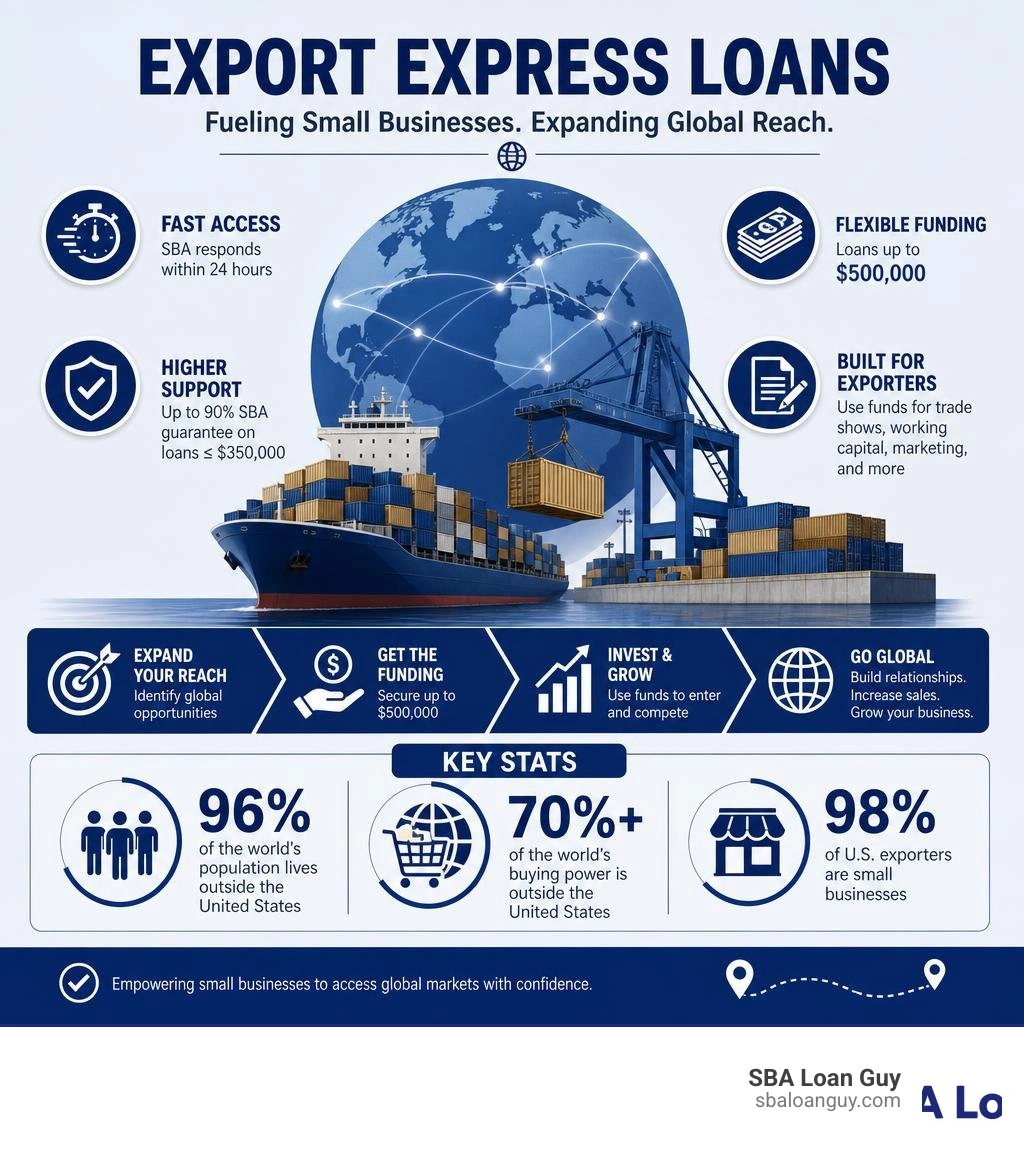
An Export Express loan is a government-backed loan of up to $500,000 that helps small businesses pay for the costs of selling products or services overseas.
Here's a quick summary of what you need to know:
Here's something that surprises a lot of business owners: 96% of the world's population lives outside the United States, and more than 70% of the world's buying power is out there too. Yet most U.S. banks are reluctant to lend money to exporters because they see international sales as too risky.
That's exactly the gap the Export Express loan was designed to fill.
Over 98% of all U.S. exporters are considered small businesses by SBA standards. And 70% of them have fewer than 20 employees. In other words, businesses just like yours are already selling overseas — and many of them are using SBA-backed financing to do it.
I'm Cesar DonDiego, a finance and accounting professional who has helped business owners structure their finances for growth and expansion, including navigating SBA financing options like the Export Express loan. In this guide, I'll walk you through everything you need to know — from eligibility to the application process — so you can decide if this loan is the right fit for your business.
Export express loan terminology:
When you want to grow your business by selling to other countries, banks can get a little scared. They worry that if something goes wrong across the ocean, they won't get their money back. That is where the U.S. Small Business Administration (SBA) steps in to help.
The SBA does not actually lend you the money directly. Instead, they act like a very helpful, wealthy friend who promises the bank, "If this business cannot pay you back, we will cover most of the bill." This promise is called a government guarantee.
The Export Express loan is a special part of the SBA 7(a) loan program. The "Express" part of the name is there for a reason: it is designed to be fast and simple. With a standard SBA loan, the bank has to send your application to the government and wait for them to review it. This can take weeks!
But with the Export Express program, the SBA gives trusted lenders the power to make the decision themselves. The lender uses their own credit application, their own forms, and their own process. Because the bank does not have to wait for the government to say yes, you get your answer much faster. In fact, once the lender submits the paperwork, the SBA responds to them within 24 hours.
If you want to understand how this compares to other fast-tracked loans, you can Learn more about the SBA Express Program to see how the SBA speeds up funding for small businesses.

Before we look at how to apply, let's talk about the basic rules of the Export Express loan. This program has some very specific features that make it different from other business loans.
First, let’s talk about the money. The absolute most you can borrow through this program is $500,000.
Because selling to other countries has unique risks, the SBA offers lenders a very high guarantee. This makes banks much happier to lend to you. The exact percentage the government guarantees depends on how much money you borrow:
| Loan Amount | SBA Guarantee Percentage | What This Means for the Bank |
|---|---|---|
| $350,000 or less | 90% | The government covers 90% of the bank's loss if you default. |
| $350,001 to $500,000 | 75% | The government covers 75% of the bank's loss if you default. |
This 90% guarantee for smaller loans is incredibly generous. For comparison, most standard SBA loans only offer a 50% to 75% guarantee.
What about the interest rates? The interest rates are negotiated between you and your lender, but the SBA sets a maximum limit to keep things fair. Typically, these rates are tied to the Prime Rate plus a markup (often around Prime + 6.5%).
The time you have to pay the loan back (called the "maturity") depends on what you use the money for:
To see how these rules fit into the broader family of SBA options, you can read the official SBA guidelines on types of 7(a) loans.
To get an Export Express loan, your business must meet a few basic rules.
For a deeper look at what lenders look for when approving these types of fast-tracked loans, check out our SBA Express Loans Complete Guide.
One of the best things about the Export Express loan is how flexible it is. You can use the money for almost anything that helps you get more international customers.
Here are some of the most common ways small businesses use these funds:
For more details on how these funds can be put to work, you can read the official SBA guide on financing international sales.
The Export Express loan is not the only tool in the SBA’s export toolbox. The SBA actually offers three different export loan programs. Let's look at how they compare so you can choose the right one.
The Export Working Capital Program (EWCP) is designed for businesses that need much larger amounts of money to handle big international orders.
While the Export Express loan stops at $500,000, the EWCP allows you to borrow up to $5,000,000.
The EWCP is highly specialized. It is usually structured as a revolving line of credit to fund specific export transactions. For example, if a foreign government orders $2 million worth of your products, you can use an EWCP loan to buy the materials needed to build and ship those products before you get paid.
The EWCP offers a 90% guarantee up to $4,500,000, but it requires much more paperwork and transaction-specific tracking than the simple Export Express loan.
If you are trying to decide between a simple line of credit and a transaction-based loan, our guide on the SBA Express Line of Credit explains how simpler revolving lines of credit work.
The International Trade Loan (ITL) is another heavy-duty option. Like the EWCP, the ITL has a maximum loan amount of $5,000,000 and offers a 90% guarantee.
However, the ITL is designed for long-term investments. It is perfect for businesses that need to buy land, build a factory, or purchase expensive machinery to compete with foreign companies or expand their global sales.
While the Export Express loan is great for quick marketing, travel, and day-to-day cash flow, the ITL is built for major construction and equipment purchases.
To compare all of these programs side-by-side, you can visit the official SBA export finance programs page.
Ready to apply? Because the Export Express loan uses the lender's own underwriting process, the application experience is very similar to applying for a regular bank loan.
Here is the typical step-by-step process:
Once your lender approves your application, they submit it to the SBA. Because this is an Express program, the SBA will give the lender a response within 24 hours.
What about collateral? Collateral is something of value (like building equity, equipment, or inventory) that you promise to give the bank if you cannot pay the loan back.
For Export Express loans of $50,000 or less, lenders are not allowed to take any collateral.
For loans over $50,000, the lender can use their own commercial collateral policy. The great news is that the SBA has a strict rule: a lender cannot decline your loan solely because you do not have enough collateral. If your business is healthy and has strong sales, a lack of collateral should not stop you from getting approved.
If you want to see the official paperwork that lenders use to finalize these loans, you can view the SBA Form Authorization.
Navigating government-backed loans can bring up a lot of questions. Here are the answers to the most common things business owners ask us.
The biggest difference is the government guarantee.
A standard SBA Express loan only offers a 50% guarantee to the bank. But an Export Express loan offers up to a 90% guarantee (for loans of $350,000 or less).
Because the bank gets a much higher safety net with the export version, they are often much more willing to approve your application—even if they think international business is risky.
To learn more about the standard version, you can read our article: What is an SBA Express Loan.
Yes! While the general rule says your business must be open for at least 12 months, the SBA will allow lenders to waive this rule.
To get the waiver, you must show that the key people running your business have clear, proven experience in exporting. If you can show a strong track record of international sales from a previous job or business, the lender can use their conventional underwriting to approve you early.
As mentioned earlier, the SBA does not want a lack of collateral to stand in the way of a great business idea.
For loans under $50,000, no collateral is allowed to be taken. For larger loans, the bank will look at what assets you have available, but they cannot reject your application simply because you do not have enough physical assets to fully back the loan. Your cash flow and business plan are what matter most.
Taking your business to the global stage is an exciting step. With 96% of the world's population living outside of our borders, international sales can completely transform your company's future. The Export Express loan is one of the fastest, most flexible ways to get the cash you need to make that happen.
But you do not have to figure out the paperwork alone.
At SBA Loan Guy, we help small business owners just like you prepare their applications, match with the perfect lenders, and walk step-by-step all the way to funding. We serve business owners in our key locations, including:
We offer a personalized pre-qualification snapshot to show you exactly what you qualify for, and we will match you with the lenders who are most likely to say yes to your export goals.
Ready to take your business global? Apply for an SBA Express Loan with us today, and let's get your products moving across the globe!

A distilled, 0–100 snapshot of how fundable you are based on credit, cash flow, equity, and documentation. Plus the top fixes to raise your score fast.
A curated shortlist of lenders that fit your profile and use of funds, with why each is a fit and exactly what they’ll want to see.
A tailored, step-by-step list of required docs and forms (formats, who provides them, and common pitfalls to avoid).
A realistic week-by-week path from pre-qual to closing, with milestones, dependencies, and an estimated target funding date.
Hands-on prep and documentation for SBA disaster programs (EIDL and others), including submissions, follow-ups, and guidance through appeals or requests for more info.
We prepare your application, match you with the
right lenders, and guide you until funding.