Learn how an SBA loan for businesses works, compare types, and get step-by-step guidance to secure funding for your small business.
June 25, 2026
An SBA loan for businesses is a small business loan that is partially guaranteed by the U.S. Small Business Administration (SBA). The SBA doesn't lend money directly — instead, it partners with approved banks and lenders, backing a portion of the loan so lenders take on less risk. That means you get better terms than you'd likely find elsewhere.
Here's a quick overview of the most common SBA loan options:
Key benefits at a glance:
If you're a small business owner trying to grow, buy a building, or acquire another business, you've probably already heard about SBA loans. But the process can feel overwhelming — with multiple loan types, strict eligibility rules, mountains of paperwork, and lenders who all seem to speak a different language.
That's exactly what this guide is here to fix.
We'll break down everything — how SBA loans work, which type fits your situation, what you need to qualify, and how to avoid the mistakes that slow most applicants down.
I'm Cesar DonDiego, a finance and accounting professional who has worked directly with small business owners on financial planning, cash flow management, and navigating funding options like the SBA loan for businesses. My hands-on experience helping business owners get their financials lender-ready gives me a practical perspective on what it actually takes to get approved.
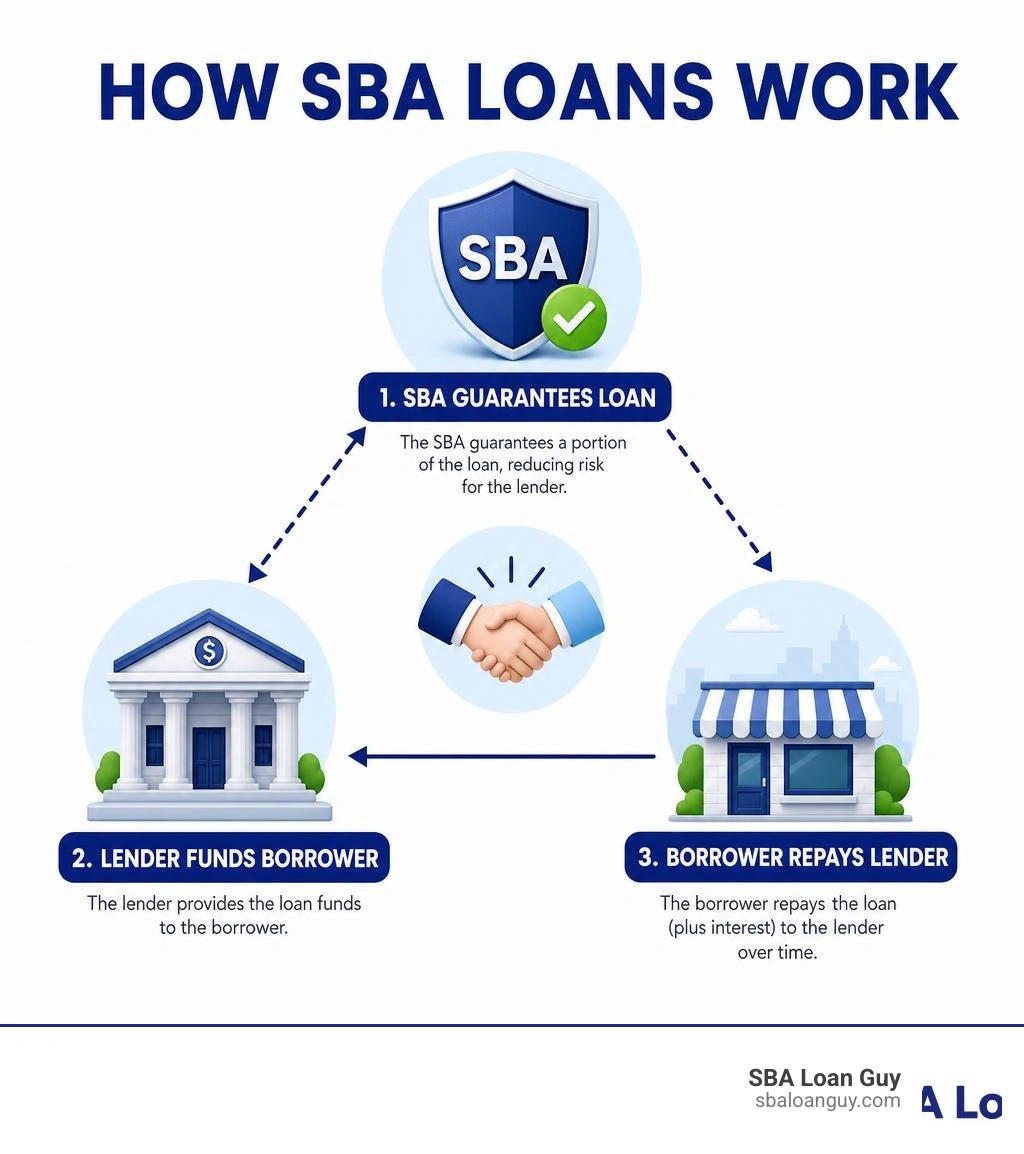
Quick look at SBA loan for businesses:
To understand how an SBA loan for businesses works, think of the government as a very helpful co-signer.
If you walk into a bank and ask for a regular business loan, the bank might be nervous. They might worry that your business is too young, or that you do not have enough collateral (like a building or expensive equipment) to secure the loan. If they think the risk is too high, they will simply tell you "no."
This is where the U.S. Small Business Administration steps in. The SBA does not actually hand you a check. Instead, they tell the bank: "If you lend this business owner the money and they cannot pay it back, we will pay you back a huge part of it."

This promise is called the SBA guarantee. For most standard loans, the SBA guarantees up to 75% for loans over $150,000, and up to 85% for loans up to $150,000.
Because the government takes on most of the risk, the partner lenders feel much safer. This reduced risk allows them to say "yes" to business owners who might not qualify for conventional bank loans. It also means they can offer you much better terms, such as lower down payments, longer repayment periods, and capped interest rates.
To explore how these features can help your bottom line, you can learn more about the benefits of SBA loans to see why they are often the cheapest and most stable cash source on the market. Every lender must follow the official SBA loan guidelines to ensure they are protecting borrowers and keeping fees reasonable.
Not all businesses need the same kind of help. A bakery that needs to buy a massive brick oven needs a different loan than a tech startup that needs cash to hire programmers. That is why there are several different SBA loan programs.
Here is a detailed comparison to help you see how the three most popular SBA loans stack up against each other in 2026:
Let's look at each of these primary loan types in detail.
If you want the Swiss Army knife of business funding, the Standard 7(a) loan is your best option. It is the SBA’s flagship program because you can use the money for almost anything.
Whether you need to buy inventory, purchase new machinery, refinance high-interest debt, buy out a business partner, or purchase commercial real estate, the 7(a) loan has you covered.
For an in-depth breakdown of how this program operates, check out our SBA 7(a) Loans Complete Guide. You can also read the Official 7(a) loan details directly on the government's website to see the latest rules.
A few exciting updates have made the 7(a) loan even better recently:
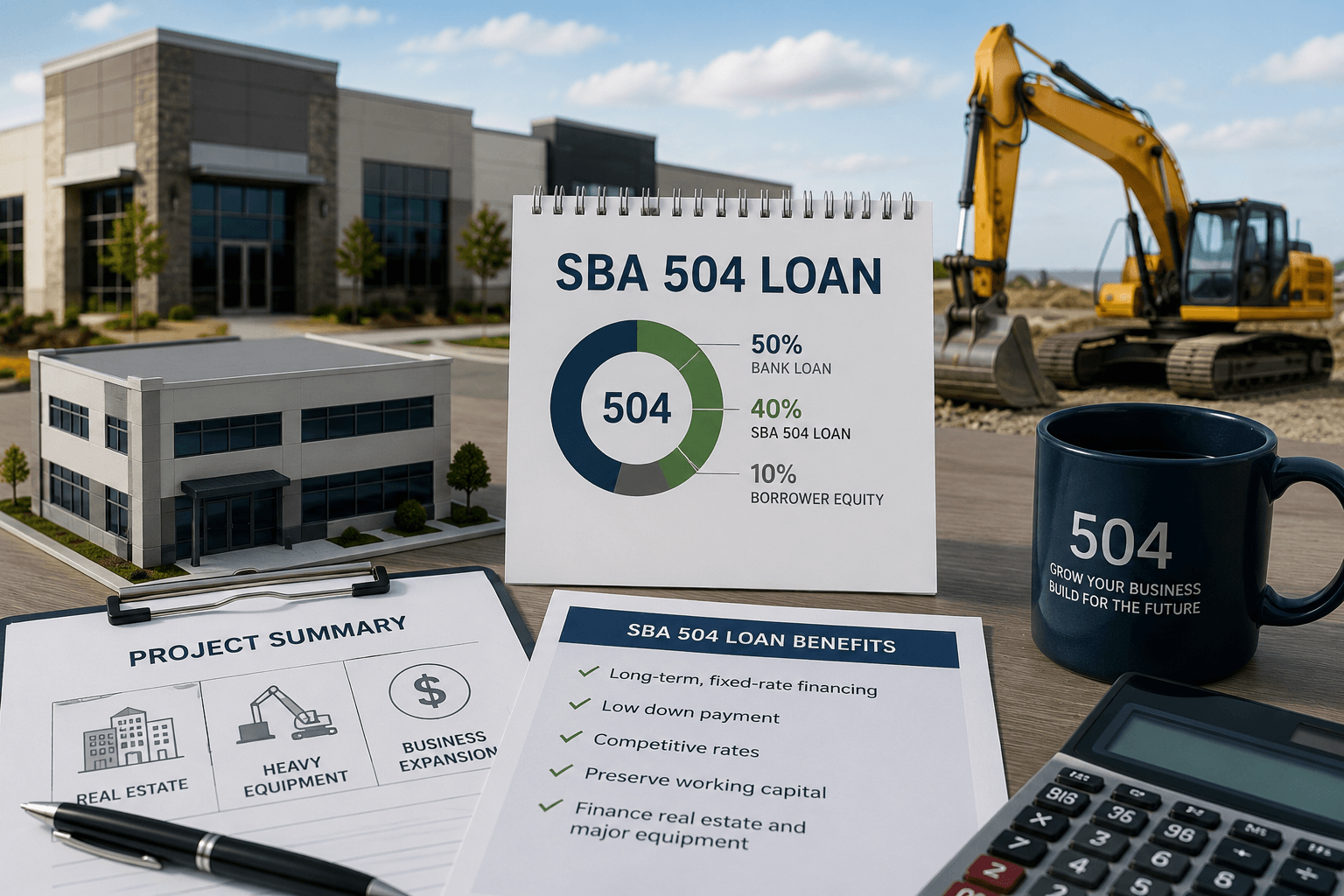
If your business is ready to buy a physical location, build a new facility, or purchase massive machinery that will last for decades, the SBA 504 loan is designed specifically for you.
The 504 loan structure is unique because it involves three parties:
This structure is a game-changer. Most traditional commercial real estate loans require a 20% to 30% down payment. Keeping your down payment at 10% means you get to keep more cash in your bank account to run your daily operations. Plus, 504 loans offer long-term, fixed-rate terms of up to 25 years, meaning your monthly payments will never surprise you.
Standard SBA loans are fantastic, but they are not known for being fast. If you need money quickly to grab an opportunity or handle an emergency, the SBA Express loan is your shortcut.
Express loans offer up to $500,000 with an incredibly fast 36-hour response time from the SBA. The trade-off is that the SBA only guarantees 50% of the loan instead of the usual 75% or 85%. Because the lender takes on more risk, the interest rates might be slightly higher, but the convenience and speed are unmatched for businesses that need to move fast.
Before you start filling out forms, you need to make sure your business fits the basic mold that the government wants to support.

To qualify for an SBA loan, your business must meet these core requirements:
For a complete breakdown of what lenders look for, check out our guide on SBA Loan Requirements. Additionally, you can review the official SBA rules on affiliation and lending criteria to see how the government calculates business size and relationship ties when multiple owners are involved.
Meeting the basic eligibility rules is just the first step. To get a lender to actually approve your application, you need to prove that your business is financially healthy. Lenders focus heavily on three major areas:
If you want to find out where you stand before talking to a bank, you can complete an SBA Loan Prequalification to get a clear picture of your borrowing power.
One of the biggest myths about SBA loans is that you do not need any collateral. While it is true that the SBA will not deny you solely because you lack collateral, lenders are required to follow their own standard collateral policies.
If you are buying real estate or heavy equipment with the loan, the lender will take a first lien on those assets. For other loans, the lender will typically secure the loan using general business assets like inventory, accounts receivable, and computers.
There is also a strict rule about personal guarantees: Anyone who owns 20% or more of the business must sign an unlimited personal guarantee.
This means that if the business fails and cannot pay back the loan, you are personally responsible for the debt. It is the government's way of ensuring that you are fully committed to making the business succeed.
Applying for an SBA loan for businesses is a journey. It is not like applying for a personal credit card where you get an answer in five minutes. It requires preparation, organization, and patience.
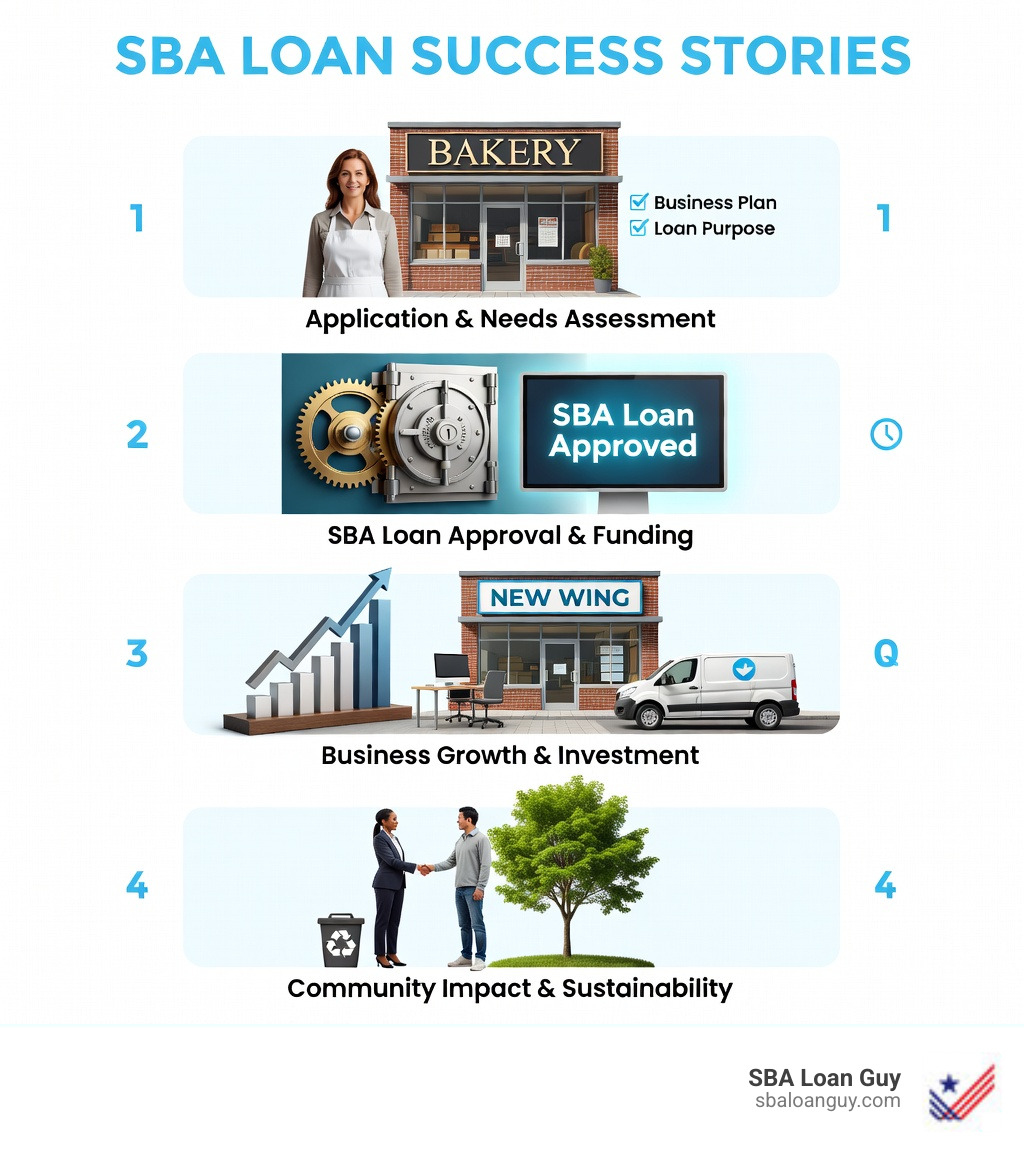
To make things easier, we have broken down the journey into simple steps:
To understand what happens during each phase of this journey, read our detailed breakdown of the SBA Loan Process. If you want professional help to avoid mistakes and speed things up, you can get expert SBA Loan Application Assistance to guide you through every step.
When choosing a bank for your SBA loan, always look for a Preferred Lender (PLP).
The SBA grants Preferred Lender status only to banks that have a proven track record of successfully processing SBA loans. This status gives the bank "delegated authority."
Working with a PLP lender can shave weeks off your timeline, often closing your loan in 30 to 45 days instead of the typical 60 to 90 days.
Many business owners get denied not because their business is bad, but because they made simple mistakes during the application process. Here are the most common pitfalls to watch out for:
We hear a lot of the same questions from business owners every day. Here are the quick, honest answers you need to know.
SBA loans are incredibly versatile. You can use the proceeds for:
If you need cash to cover seasonal dips or payroll, you can learn more about an SBA Working Capital Loan. If your goal is to buy out an existing competitor or acquire a new location, read our guide on SBA Loans for Business Acquisition to see how those transactions are structured.
SBA loan interest rates are tied to a base rate, most commonly the Wall Street Journal (WSJ) Prime Rate (which is 6.75% as of May 2026). Lenders are allowed to add a markup (called a spread) on top of the base rate, but the SBA sets strict legal maximums so lenders cannot overcharge you.
For loans over $250,000, the maximum variable interest rate is typically capped at Prime + 3.0% (making the maximum rate 9.75% in May 2026). Smaller loans have slightly higher caps to compensate lenders for the extra work involved. To see the most up-to-date pricing and options, check out the Current SBA 7(a) Loan Rates page.
The timeline depends heavily on the loan type and the lender you choose:
Securing an SBA loan for businesses can be the key that unlocks the next level of growth for your company. Whether you are operating in The Woodlands, Houston, California, Orlando, Chicago, Indianapolis, New York City, or San Francisco, having the right financial backing makes all the difference.
But you do not have to navigate the complex world of government rules, financial ratios, and lender matching alone.
At SBA Loan Guy, we specialize in making this process simple, clear, and stress-free. We provide a personalized pre-qualification snapshot, match you with the perfect Preferred Lenders for your specific industry, and offer step-by-step guidance to ensure your application gets approved.
Ready to see how much funding your business can qualify for? Get started with SBA Loan Guy today and let us help you secure the capital you need to build your dream.

A distilled, 0–100 snapshot of how fundable you are based on credit, cash flow, equity, and documentation. Plus the top fixes to raise your score fast.
A curated shortlist of lenders that fit your profile and use of funds, with why each is a fit and exactly what they’ll want to see.
A tailored, step-by-step list of required docs and forms (formats, who provides them, and common pitfalls to avoid).
A realistic week-by-week path from pre-qual to closing, with milestones, dependencies, and an estimated target funding date.
Hands-on prep and documentation for SBA disaster programs (EIDL and others), including submissions, follow-ups, and guidance through appeals or requests for more info.
We prepare your application, match you with the
right lenders, and guide you until funding.