Discover the credit requirement for SBA loan approval and learn how to meet lender standards for fast approval.
June 24, 2026
Understanding the credit requirement for SBA loan approval is simpler than most people think — but the details matter.
Here is a quick answer if you need it fast:
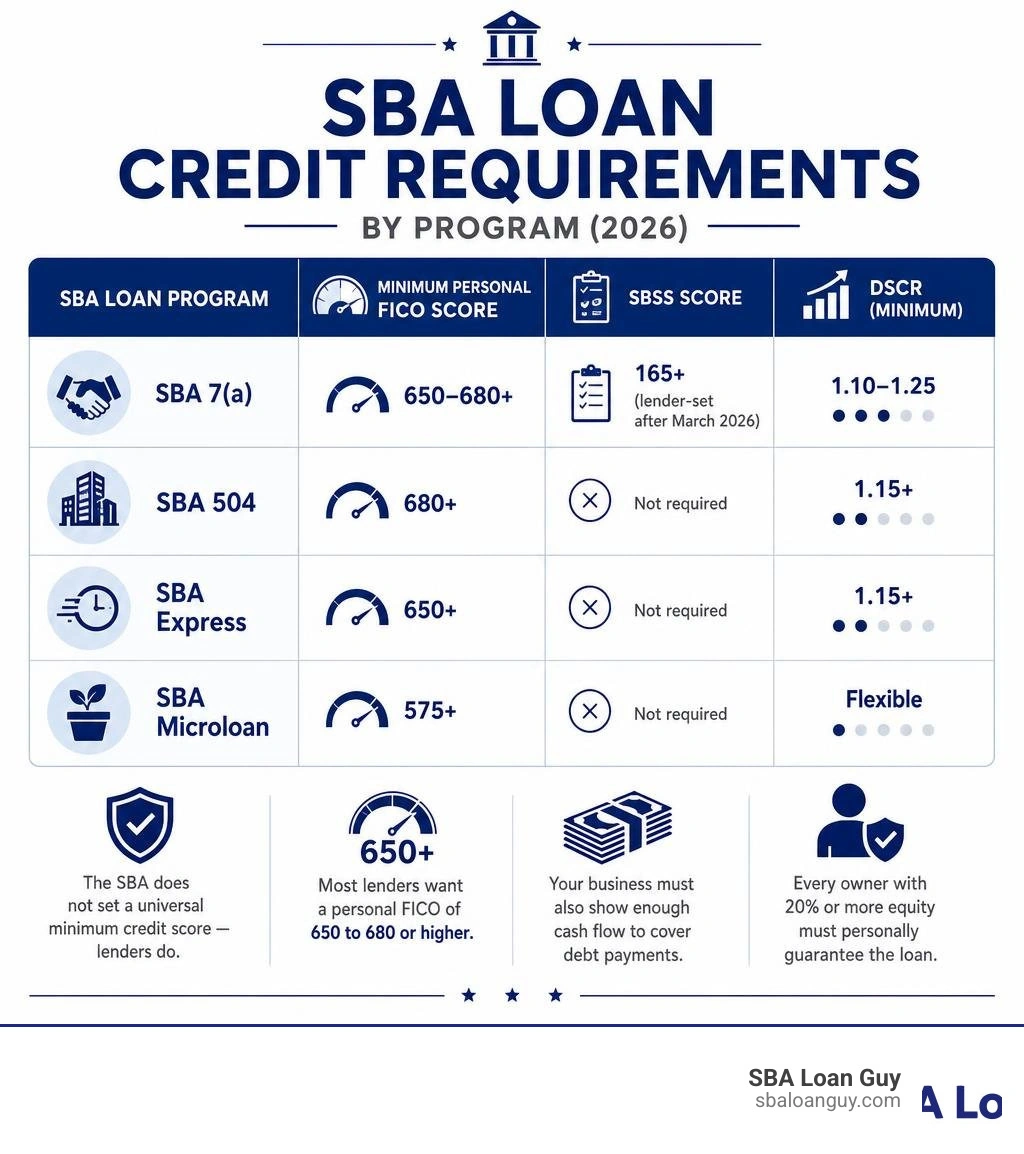
| SBA Loan Program | Minimum Personal FICO | SBSS Score | DSCR |
|---|---|---|---|
| SBA 7(a) | 650–680+ | 165+ (lender-set after March 2026) | 1.10–1.25 |
| SBA 504 | 680+ | Not required | 1.15+ |
| SBA Express | 650+ | Not required | 1.15+ |
| SBA Microloan | 575+ | Not required | Flexible |
Key facts:
Most business owners assume they won't qualify for an SBA loan because of their credit. Often, they're wrong. The SBA's job is to reduce lender risk so that more small businesses can get funded — even ones that wouldn't qualify for a standard bank loan. But that doesn't mean there are no rules. Lenders still evaluate your personal credit history, your business finances, and your ability to repay before they say yes.
The confusion comes from one simple fact: the SBA sets a floor, but each lender builds its own requirements on top of that floor. So the "right" credit score depends heavily on which lender and which loan program you're applying to.
I'm Cesar DonDiego, a finance and accounting professional with hands-on experience helping small business owners understand the credit requirement for SBA loan programs and structure their finances for approval. In the sections below, I'll walk you through exactly what lenders look for — and what you can do to put your best foot forward.
Essential credit requirement for sba loan terms:
When you apply for an SBA loan, we are looking at two different types of credit: your personal credit and your business credit. The government wants to make sure that the people receiving taxpayer-backed loans have a history of paying their bills on time. This is what the SBA calls "credit soundness."
However, the Small Business Administration itself does not actually hand out the money. Instead, they partner with banks, credit unions, and online lenders in places like Houston, Chicago, New York City, and California. The SBA guarantees a portion of the loan—up to 85 percent for loans of $150,000 or less, and up to 75 percent for loans above $150,000.
Because the bank is still on the hook for the remaining percentage of the money, they add their own rules on top of the SBA's baseline guidelines. In the lending industry, these extra rules are called lender overlays. For example, while the SBA might technically allow a lender to approve a borrower with a 600 credit score, a specific bank in San Francisco or Indianapolis might have a lender overlay that requires a minimum score of 680.
This is why getting an SBA Loan Prequalification is so helpful. It helps you see where you stand before you go through the official application process. The most common program is the 7(a) loans program, which is highly flexible and can be used for working capital, buying equipment, or purchasing real estate.
Your personal FICO score is a three-digit number that tells lenders how good you are at managing your personal money. It is the single most important number in your application. Lenders look at this score because, in the small business world, personal financial habits usually reflect business financial habits.
Here is how the personal credit score requirements break down across different programs:
To understand how these scores fit into the broader federal lending landscape, you can read more about government small business loans requirements.
In addition to your personal FICO score, the SBA has historically used a tool called the FICO Small Business Scoring Service (SBSS) score to pre-screen applications.
The SBSS score ranges from 0 to 300. It is a special score that combines:
For a long time, the SBA set a mandatory minimum SBSS score of 165 for 7(a) Small loans (which are loans up to $500,000). Some strict online lenders even pushed their internal requirements up to 170 or 180 depending on whether the business had employees.
However, things changed in early 2026. Under the latest SBA updates, the rigid requirement for lenders to use the SBSS score was sunsetted. This means lenders now have the freedom to use their own modern credit evaluation models instead of relying strictly on the FICO SBSS system.
While this makes the application process more flexible, it does not mean business credit is ignored. Lenders will still pull your business credit reports to check for any late payments, open tax liens, or bankruptcies associated with your business EIN.
Lenders do not just look at your credit score and make a decision in five seconds. They perform a deep dive into your entire financial life. They want to make sure your business makes enough money to pay back the loan comfortably while still having enough cash left over to handle emergencies.

When our team helps match you with lenders across our locations—from New York City to California—we look at several pillars of financial health:
If your credit score is the lock, your cash flow is the key. Lenders measure your cash flow using a metric called the Debt-Service Coverage Ratio (DSCR).
To explain this in the simplest terms: the DSCR compares your business’s annual net operating income to your annual debt payments (including the new SBA loan you want to get).
The math looks like this:$$\text{DSCR} = \frac{\text{Net Operating Income}}{\text{Annual Debt Service}}$$
If you want to dive deeper into how your business profits affect your loan eligibility, check out our guide on income requirements for sba loan.
Many business owners ask us: "If I have a great credit score, do I still need to pledge collateral or sign a personal guarantee?"
The short answer is yes. The SBA has very strict rules regarding personal guarantees and collateral:
You can learn more about these specific rules by reading the official SBA guidelines on terms, conditions, and eligibility.
One of the biggest points of confusion for business owners is the difference between being eligible for an SBA loan and being approved for one.
Just because you meet the basic government eligibility rules does not mean a bank is forced to lend you money. They will still put your application through their strict risk evaluation process.
| Evaluation Area | SBA Eligibility Baseline | Typical Lender Approval Criteria |
|---|---|---|
| Personal Credit | No official minimum score; must show good character | 650 to 680+ FICO score depending on the program |
| Business Cash Flow | Must show ability to repay the loan | DSCR of 1.15:1 to 1.25:1 |
| Years in Business | Startups are eligible | Prefers 2+ years in business (startups need 10-20% down payment) |
| Collateral | Lack of collateral is not an automatic rejection | Will secure all available business and personal real estate assets |
The entire purpose of the SBA loan program is to help businesses that cannot get regular bank loans. This is called the Credit Elsewhere Rule.
Before a lender can offer you an SBA-guaranteed loan, they must verify and document that your business is unable to obtain credit from non-government sources on reasonable terms.
Historically, under old rules, lenders had to write out a long, detailed explanation in their credit memos to prove why you couldn't get a regular loan. However, under recent updates like SOP 50 10 8, the SBA brought back stricter requirements for this test. Lenders must now write a fact-specific, reasoned narrative in their credit files explaining exactly why you need the SBA guarantee.
Acceptable reasons include:
For the exact policy wording, you can refer to the official Info Notice 5000-848663.
The SBA regularly updates its Standard Operating Procedures (SOP) to keep up with the economy. Several major updates went into effect in March 2026 that directly impact the credit requirement for sba loan applications:
To see how these rules were rolled out, you can read the official Procedural Notice 5000-846607.
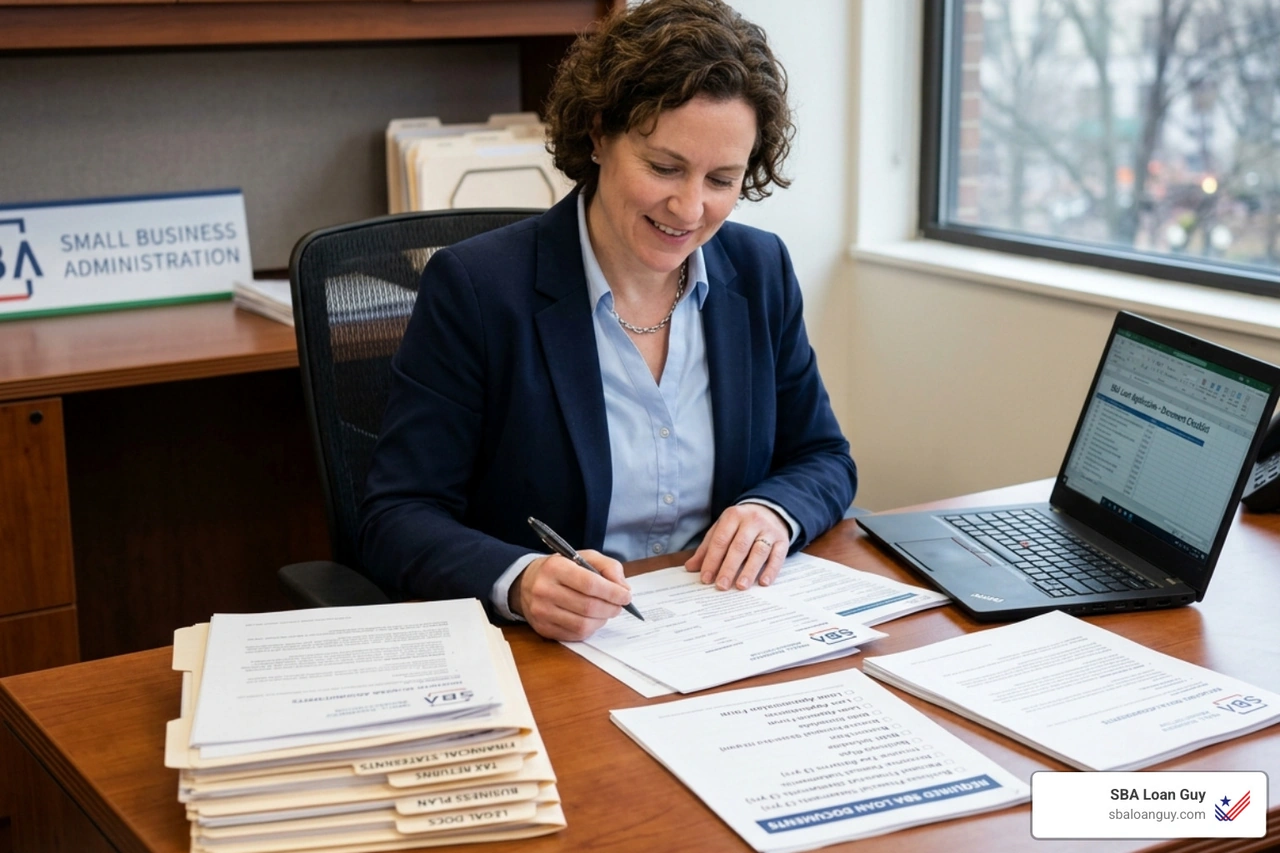
Getting your financial documents organized is the best way to speed up your loan approval. Most delays in the SBA process do not happen because a borrower is rejected; they happen because the lender is waiting on missing or outdated paperwork.
When you work with us at SBA Loan Guy, we help you compile a complete package so that underwriters can review your file quickly. Here is the core checklist of what you will need:
For a complete, downloadable guide to these files, check out our SBA 7(a) Loan Requirements PDF.
If your credit score is currently below the 650–680 range, do not panic. Credit scores are dynamic, and you can take several steps to improve your score before we submit your application to a lender:
There is no single "official" minimum score set by the SBA itself. However, in the real world of banking, the practical minimum for a standard 7(a) loan is 650, with most lenders strongly preferring 680 or higher. If you are applying for an SBA Microloan, you can find flexible lenders who will accept scores down to 575 or even 540 in exceptional cases.
Yes, but it is more difficult and requires "compensating factors." If your credit score is low because of a one-time life event (like medical bills or a past divorce) rather than a pattern of financial irresponsibility, lenders may look past it if your business has excellent cash flow, a high DSCR (like 1.35 or higher), and strong collateral. You can also look into CDFI lenders or the SBA Microloan program, which are designed to support borrowers with imperfect credit.
The three most common credit-related reasons for denial are:
Navigating the credit requirement for SBA loan approval does not have to be overwhelming. While the rules can seem complex, they are designed to ensure that your business is set up for long-term success. By understanding what lenders look for—from your personal FICO score to your business cash flow (DSCR)—you can take control of your financial narrative and present a strong, clean application.
At SBA Loan Guy, we specialize in taking the guesswork out of the process. Based in The Woodlands, TX, we proudly serve business owners across Houston, California, Florida, Chicago, Indianapolis, and New York City. We provide you with a personalized pre-qualification snapshot, match you with the perfect lenders from our curated network, and guide you step-by-step all the way to funding.
Ready to take the next step and secure the capital your business deserves? Let us do the heavy lifting for you.
Apply for an SBA 7(a) Loan with us today and let's get your business funded!

A distilled, 0–100 snapshot of how fundable you are based on credit, cash flow, equity, and documentation. Plus the top fixes to raise your score fast.
A curated shortlist of lenders that fit your profile and use of funds, with why each is a fit and exactly what they’ll want to see.
A tailored, step-by-step list of required docs and forms (formats, who provides them, and common pitfalls to avoid).
A realistic week-by-week path from pre-qual to closing, with milestones, dependencies, and an estimated target funding date.
Hands-on prep and documentation for SBA disaster programs (EIDL and others), including submissions, follow-ups, and guidance through appeals or requests for more info.
We prepare your application, match you with the
right lenders, and guide you until funding.