How a partner buyout looks to a lender, with a worked example and a preparation checklist for the owner who is staying.
October 30, 2026
When one partner leaves and the other stays, the business often has to find the money to pay for the departing partner's share. Lenders treat that as a change of ownership, and SBA financing for partner buyouts is one way some owners fund it. The lender wants to know what the share is worth, where the money comes from, and whether the business can carry new debt without the person who is leaving. SBA Loan Guy helps Houston-area owners organize those answers before they approach a lender.
Note: the valuation, tax treatment and legal terms of a buyout are matters for your CPA and your attorney. This guide explains how a lender tends to look at the financing side, and approval is never automatic.

In a buyout, the remaining owner or owners purchase the departing partner's ownership interest. The price may be paid at closing, over time, or in a mix of both, and the purchase may be made by the remaining owner personally or by the company, depending on how the deal is set up. Because ownership is changing, the lender reviews the transaction much as it would review a purchase from a third party, with the added question of how the business works once a partner is gone.
A lender usually starts with these questions.
Program rules and lender policies change, so confirm what applies to your deal against SBA's Standard Operating Procedure (SBA SOP 50 10 (check the current revision)) and the lender's own policy. The SBA 7(a) program page covers the basics of the most common SBA program.
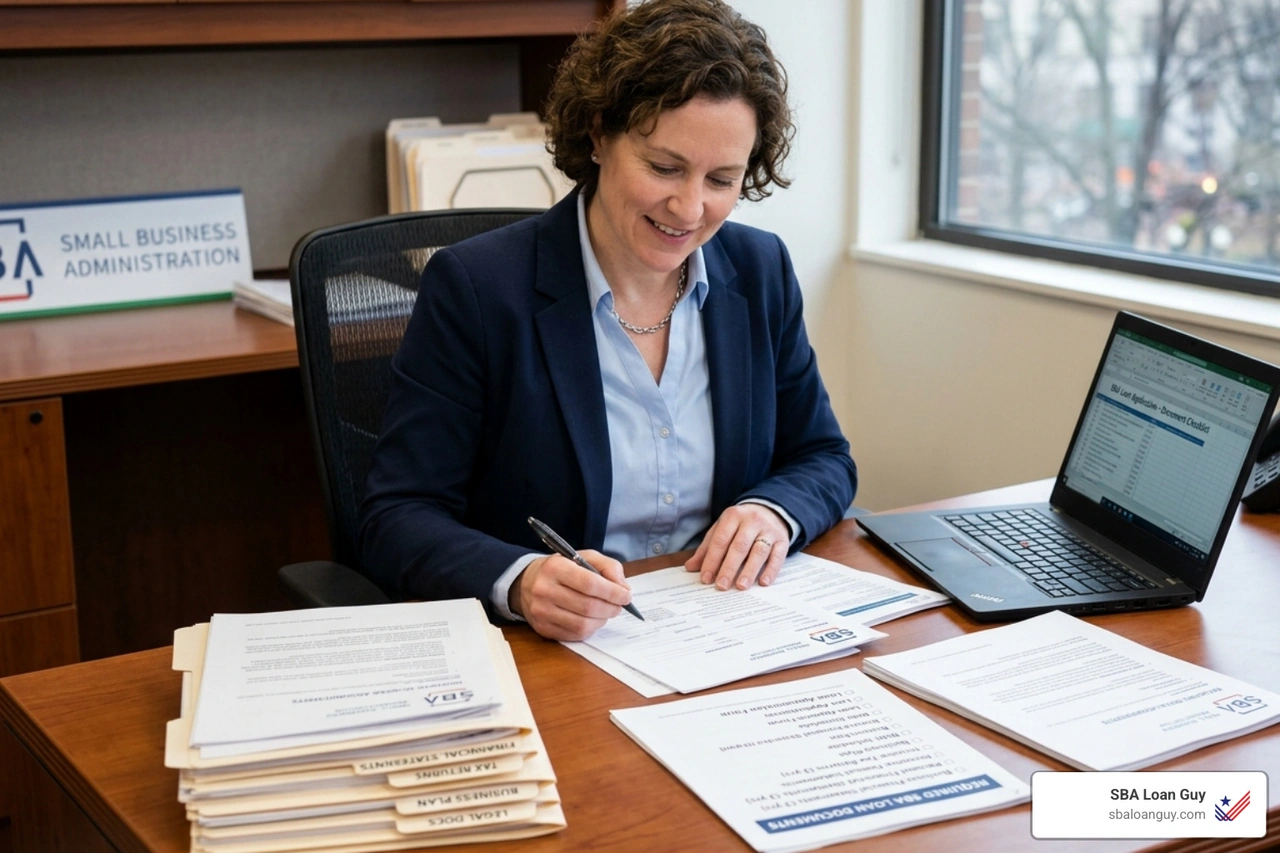
The package for a buyout tends to center on a few items.

The lender begins with the business's cash flow, then adjusts it for what changes at closing. If the departing partner drew a salary for a real job, that cost does not disappear. Someone has to do the work, so the lender usually keeps a market-level replacement cost in the numbers. New loan payments are then added on top.
The lender also looks at concentration and continuity. If a few customers or suppliers dealt mainly with the departing partner, the lender may ask how those relationships will be kept. Depending on the lender and the size of the deal, it may also ask for an independent valuation, so find out early whether that applies.
For example, two equal partners own a business that earns $300,000 a year before any owner pay. Each draws $80,000 for working in the business. The partners agree the business is worth $1,000,000, so the buyout of a 50 percent interest is priced at $500,000. Suppose the remaining owner puts in $100,000 of cash and finances $400,000. The cash and loan amounts here are only an illustration. Ask the lender for the current minimum contribution.
After closing, the remaining owner still draws $80,000, and the business hires a manager at $70,000 to cover the departing partner's role. Cash available for loan payments is $300,000 - $80,000 - $70,000 = $150,000. If annual payments on the new loan are $65,000, that is about 2.3 times the payments ($150,000 divided by $65,000).
Now suppose a customer who worked mainly with the departing partner leaves and cash flow drops by $40,000. Cash available becomes $110,000, or about 1.7 times the payments. Lenders look at this kind of downside, and each lender sets its own cushion, so a lender may want to see how the remaining owner would respond.
1. Agree on the value and the basis for it. Put the valuation approach in writing, and keep the financial statements it relies on.
2. Map the funding. List each source of money, how much it covers and the documents that prove it, including the remaining owner's cash.
3. Review the partner agreement with your attorney. Confirm the buyout can proceed under its terms, and note any consents you need.
4. List every guarantee and shared obligation. Include loans, leases, vendor accounts and credit cards, and ask each creditor what a release would require.
5. Write the transition plan. Show who takes over each of the departing partner's responsibilities, and when.
Can the company make the purchase instead of the remaining owner?
Sometimes. How the transaction is structured affects who borrows and who owns what afterward, so ask your CPA, attorney and the lender before settling on it.
Will the departing partner have to sign lender documents?
Possibly. A lender may ask for the signed buyout agreement and for acknowledgments from the departing partner. What is required depends on the lender and the deal.
What if the partners disagree on value?
An independent valuation can help both sides work from the same number. Your attorney can advise on what the partner agreement says about resolving disputes.
Can part of the price be paid to the partner over time?
That is common in buyouts, but how a lender treats those payments depends on its policy and on SBA requirements. Ask early, and do not assume the arrangement will be accepted.
A partner buyout is a financing request, a valuation question and a legal agreement at the same time. Lenders want to see a price with a basis, funding that can be traced, a partner agreement that allows the deal, and a plan for running the business without the person who is leaving. Bring your CPA and attorney in early, and expect the lender to test the downside. Doing so does not promise an approval or any particular terms.
Planning to buy out a partner? Contact SBA Loan Guy to talk through your valuation, funding sources and timeline before you approach a lender.
This article is general information only. It is not legal, tax, accounting or financial advice. SBA Loan Guy is not a lender and is not affiliated with or endorsed by the U.S. Small Business Administration. Program rules, eligibility and requirements change, so confirm current details with a licensed lender and SBA.gov before you make a decision.

A distilled, 0–100 snapshot of how fundable you are based on credit, cash flow, equity, and documentation. Plus the top fixes to raise your score fast.
A curated shortlist of lenders that fit your profile and use of funds, with why each is a fit and exactly what they’ll want to see.
A tailored, step-by-step list of required docs and forms (formats, who provides them, and common pitfalls to avoid).
A realistic week-by-week path from pre-qual to closing, with milestones, dependencies, and an estimated target funding date.
Hands-on prep and documentation for SBA disaster programs (EIDL and others), including submissions, follow-ups, and guidance through appeals or requests for more info.
We prepare your application, match you with the
right lenders, and guide you until funding.